Frustrated with your scheduling? Try the easiest-to-use calendar app, made by and for maid service owners.
Editor’s note: This post was updated 9 September 2026 to acknowledge the changes in conversational marketing styles and capabilities that have evolved since the talk was originally given in 2026. The original talk has been preserved.
Over the years, cleaning business owners have adopted new digital marketing processes to attract new clients and nurture those relationships. But until recently, providing quotes and booking cleaning appointments has stubbornly stayed pretty much the same.
Post-2020, it became standard practice to put a form on your website for people to fill out to get a quote or estimate. Most cleaning business owners now have such a web form — so the new challenge lies in how to get your clients to that form as quickly as possible.
For a while, streamlining your customer journey into only a few steps to book an appointment was enough. But as competition continues to grow, you can add real-time options for booking the services your clients want with conversational marketing strategies and automated messaging.
One of the most efficient ways to incorporate conversational marketing into your business is to use chatbots and automated messaging to converse with clients on your website and on social media, in real time. Answering clients as fast as possible means you’re more likely to beat the competition, and when you present the right information at the right time, you’ll seem impressive to new clients.
But when you incorporate conversational marketing strategies into your maid service, you also create an open dialogue between your service and your buyer. These conversations can result in more website visitors requesting quotes and scheduling cleanings in real-time.
In this post, we’ll dive deeper into how you can use conversational marketing, automated messaging, and chatbots to communicate with your customers in real-time.
Table of contents
Watch the Full Talk from the 2020 Maid Summit
This post was originally inspired by Mike Callahan’s talk at the 2020 Maid Summit. In this post, you’ll learn his key philosophies around how to use conversational marketing tactics to automate your sales and booking process.
Mike is a Certified Infusionsoft Partner and Certified Customer Acquisition Specialist who has helped over 300 businesses automate their sales and customer acquisition process. He created a turnkey solution that revolutionized his business, Simple Growth Systems, and is now teaching the lessons he learned while growing his company.
What is Conversational Marketing?
Conversational marketing is the ability to communicate one-on-one with clients across multiple channels, from email to live chat on your website. These two-way communications with your clients online make interactions with your business feel easier and more natural.
Rather than relying on clients to fill out transactional forms and wait for a response, conversational marketing moves clients through your sales process more efficiently. Chatbots can pick from a variety of automated messaging options to keep conversations flowing while you’re not around, making sure “someone” is always on and available to answer client questions.
Conversational marketing, when implemented well, can impact your business across the board. You’ll need fewer people on staff to reply to emails and quotes, and automations mean more business can roll in smoothly, increasing business.
For cleaning business owners, this looks like using real-time conversation to get the information you need from your clients to provide them with quotes and send them a link to book a cleaning almost instantly. But making sure these experiences are seamless depends on the chatbot you choose to use.
How Chatbots Can Improve Your Sales Process
In most maid services, the sales process looks something like this:
- A potential customer finds your website and fills out a booking or contact form
- They get an email confirmation letting them know that you received their email and will provide them with an estimate or return their call soon.
- Their email address and information goes into a CRM, and someone on staff (usually you) manually qualifies them as a lead
- Then this person calls or emails the lead with a quote and prompts them to book a cleaning appointment
While this process still works very well for cleaning businesses, there is an easier way to convert customers with much less manual work.
This system breaks down because it requires putting one person in charge of manually following up and responding to anyone who fills out the form. This limits the amount of time you can quote and accept new appointments to however much time that one person, who is still usually you, can spend responding to quote requests.
Adding a chatbot to your website and social media platforms means clients get a response at any time of day or night, and you or your office manager stop needing to do so many tedious, repetitive tasks.
Real-time messaging also helps to make sure that fewer leads fall through the cracks. Everyone who visits your website has the same opportunity to receive an estimate, and you can follow up with any leads that don’t convert during a chat.
Chatbots also reduce the time it takes for leads to find your booking form from the moment they log on to the moment they book.
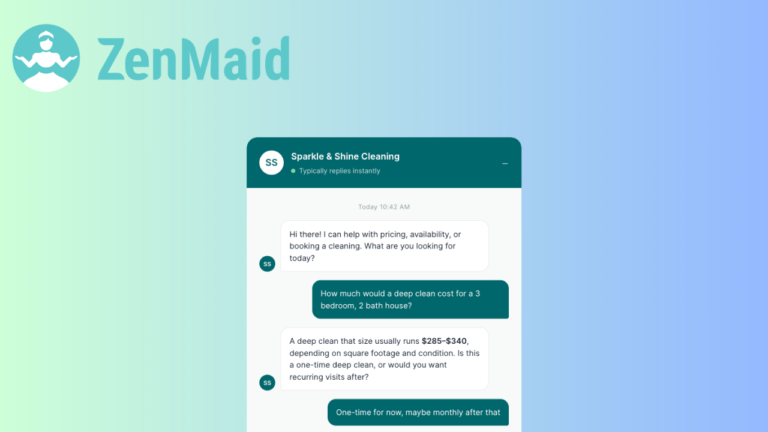
Here’s an example of what a chatbot might look like on your website:

The chat bubble expands to open a window where clients can ask questions or be prompted to take a specific action, like booking an appointment.
Conversational marketing helps clients make more efficient use of your website, but the same tactics can be applied to any interface you use to interact with clients. The “marketing” part of conversational marketing means that you can apply this same strategy to messages you receive on social media.
Using Chatbots and Automated Messaging on Social Media
Most social media platforms have auto-reply features or integrations that you can use to reply to client messages. Both Instagram and Facebook Messenger offer users with Meta Business accounts the option to automate messaging according to a variety of triggers.
Let’s go through an example of what your sales process can look like when implementing conversational marketing strategies using a chatbot on Facebook.
A visitor lands on your Facebook page. Your chatbot asks them if they want an instant quote:

They click a button, and it starts qualifying them as a lead by asking questions about their home. If they are qualified, the bot sends them an estimate and can even share a link to your booking form right then. If they still have more questions or have a special request, then someone on your team can manually reach out.
This type of real-time messaging eliminates the time gap between lead capture and qualifications.
When you set up a chatbot, you’ll need to prepare the questions your clients have to answer in advance and set canned responses and prompts to common queries. It’s a good practice to have these saved in a document somewhere as a source of truth, so that if you need to change up your chatbot sequences later, you can edit them all in one place and copy/paste them into each chatbot platform.
How Chatbots Support the 3-Step Sales Process
Step 1 – Capture
Capture the visitor on your website as a lead by promoting a bot to message them from your site. You can program your chatbot to start with a warm welcome message, ask what they need help with, or ask a simple yes or no question to get them started.
Somewhere in this conversation, you should ask the visitor if they want to receive an estimate for a house cleaning.

Step 2 – Qualify
If a client asks for a quote, the bot needs to ask the right questions to qualify them as a potential lead. A great first question is to ask for their address to make sure they’re in your service area:

Then, in the chatbot’s backend, you can include the areas you service. When a client sends their address through the chat, your bot can let them know if you service their area or not.
You can also configure your bot to link to Zillow, which can pull estimated square footage information from that address that you can use to calculate an estimate.
Step 3 – Connect and Convert
Use this opportunity while your lead is engaged to send them an estimate and usher them into the next part of your sales process. Ask them for their email address to send them the quote, or provide them with an estimate in the chat and a link to book their appointment.
Before providing instant estimates, make sure that you have a solid understanding of your pricing model to make sure that you don’t underprice your estimate.
If you’re confident with your pricing model, you can prompt them to book a cleaning right from the quote. If you still need to collect additional information for a more accurate estimate, let them know that someone will reach out to them shortly, and make it a priority to have someone on your team give them a call.
Depending on how you implement your chatbot and which pricing strategy you use, you may be able to program your chatbot to give estimates independently. But if you want to price manually and confirm appointments after they are requested, you can still put leads on pause and approve them when you come in the next day.
Another option is to create your own system for providing quotes, such as using a high-low price range or providing hourly pricing estimates.
If you want to provide instant bookings, sync the chatbot on your website or social media to your CRM using Zapier and link it to ZenMaid. This will allow them to book a cleaning right from that conversation. If you use ZenMaid for scheduling software, your new appointment will show up in your calendar automatically, with the lead tagged by source.
Final Thoughts
Maid services face the challenge of turning website visitors into booked clients in fewer steps. Static lead forms (like the ones we offer here at ZenMaid) are a great tool for capturing leads from your website. However, there’s a growing need for a more conversational and real-time approach to automating the quote and booking process.
More and more people are looking for instant solutions and answers to their questions. The more steps it takes from the time someone visits your website until they can book a cleaning, the more likely you are to lose them to one of your competitors.
Using automated messaging to help you collect customer information and sending quotes in real-time builds a conversation with your customers. These strategies can work with the forms and systems you’ve already built and eliminate the need for manual quotes and lead qualification.
Incorporating more conversational marketing strategies can help you and your staff reclaim their time spent on tedious tasks and allow your team to focus on building relationships and closing more deals.
About the Maid Summit
The Maid Summit is an annual online event that brings together the most successful leaders in the cleaning industry, like Debbie Sardone, Angela Brown, Courtney Wisely, Amy Caris, Chris Schwab, and more.
Get free access to master classes and workshops that will help you grow, scale, and automate your cleaning business so you can get more leads and create more profit. Make sure you’re on our email list to find out how to get free tickets to the next event.